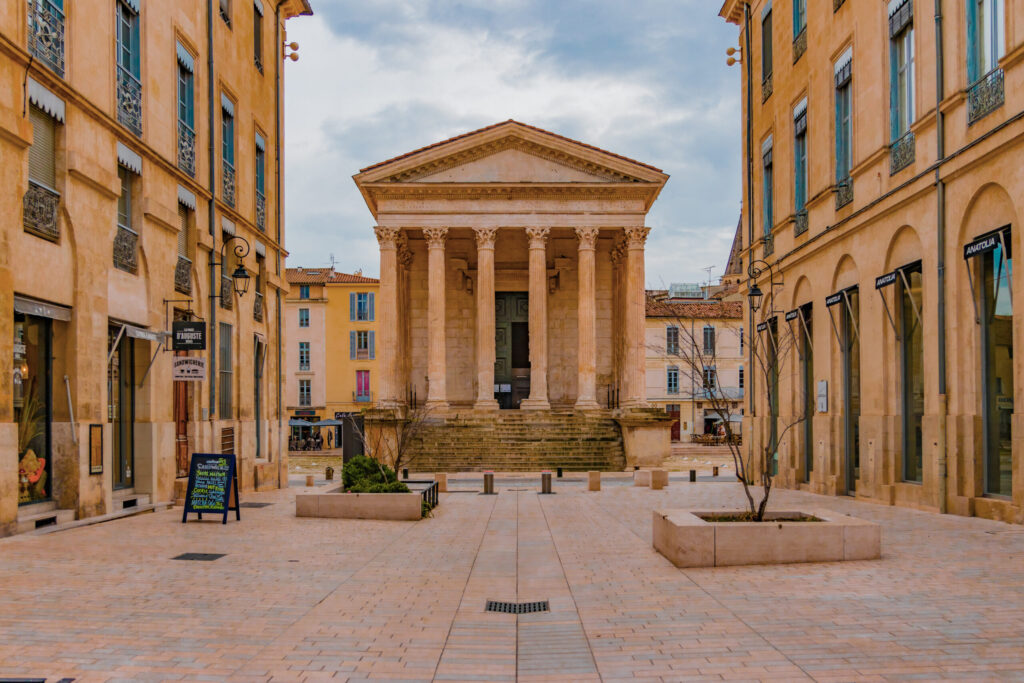
Maison Carrée
A name dating back to the Renaissance
Although it is rectangular in shape, the Maison Carrée has borne this name since the 16th century. At that time, a rectangle was referred to as a “carré long.” That is why this Roman temple, which is more than 2,000 years old, is still known by this name.
A building designated as a UNESCO World Heritage Site
Like all Roman temples, the building rests on a podium. Standing 2.65 meters high, it sets the temple apart, elevated above the bustle of the public square. The stones used come from several quarries located in the vicinity of the city. The stones for the podium and staircase come from Barutel, while those for the columns, walls, and entablature of the monument come from the Bois des Lens. This very dense white limestone, of a quality similar to marble, allows for the creation of sculptures of great finesse. The interior of the temple consists of a single room, the cella, preceded by a pronaos. The roof of the pronaos is supported by 10 columns, 6 of which are on the facade. The remaining 20 columns are embedded in the walls of the cella. Standing 9 meters tall, these 30 Corinthian columns are crowned by capitals adorned with a double row of acanthus leaves. Above the capitals, the entablature is adorned with a frieze of foliage motifs directly inspired by models created in Rome during the same period. Like other roofs in the Roman city, the Maison Carrée is covered with alternating flat and curved tiles—the tegulae and imbreces.
A temple in memory of the princes of youth
The Maison Carrée is undoubtedly the best-preserved Roman temple in the world. Built in the early years of the 1st century, this structure is dedicated to the worship of the imperial family. Inspired by the temples of Apollo and Mars Ultor in Rome, the Maison Carrée impresses with the harmony of its proportions and the majesty that emanates from this exceptional monument. In Roman times, it was located south of the forum, a vast public space that formed the heart of the city. The entire southern section of the forum features a platform raised above the level of the square, remnants of which are still visible on either side of the temple’s staircase. On the platform, a large stone altar—now lost—was used for religious ceremonies. Unlike Christian churches, where the temple was reserved for the deity, priests, and initiates, worship was then conducted in front of the god’s dwelling.
Plan Your Visit
Thanks to the redesign of our showcase area, you can now more easily access:
- Digital Immersion: New Audio Guides and Interactive Content.
- Practical Information: Hours, prices, and online reservations to avoid waiting.
Step inside the Maison Carrée. Feel the history.
FAQ
Regular Hours of Operation
- Open 7 days a week, year-round.
- Last admission: 15 minutes before closing
- January, November, December: 10:00 a.m. – 4:30 p.m. (Closes at 5:00 p.m. during the Christmas break)
- February: 10:00 a.m. – 4:30 p.m. (Extended hours until 6:00 p.m. during the February school break)
- March & October: 9:30 a.m. – 6:00 p.m.
- April & May: 9:30 a.m. – 6:30 p.m.
- June & September: 9:30 a.m. – 7:00 p.m.
- July & August: 8:00 a.m. – 9:00 p.m.
Directions, Train & Parking
-
The Roman monuments of Nîmes are located 30 minutes from the Pont du Gard, Arles, and Montpellier; 45 minutes from Avignon and Orange; and 1 hour and 30 minutes from Marseille, Aix-en-Provence, and Narbonne.
- By train (ideal): The Nîmes Centre TGV station is just a 5-minute walk from the Arènes.
- By car: Take the A9 or A54 highway, exit at Nîmes and follow signs for “Centre-ville,” then “Arènes.”
- 🚗 Where to park (Private vehicles): The “Arènes” paid underground parking garage on Boulevard de Bruxelles (at the foot of the monument) or the “Maison Carrée” underground parking garage on Boulevard Victor Hugo.